
People living in Vancouver often complain about feeling isolated, disconnected, alone. Part of it has to do with the city’s recent growth: too many people are newcomers. Another part has to do with it being expensive, so, people don’t stay for long. Once they have children or want to settle and buy property, they end up leaving because it’s not affordable. With so much of a transient population, it’s obvious that developing long-lasting relationships and a sense of community is a challenge.
Though Van couver is a very diverse city, many people never step out of their comfort zone and get to know others who might be in any way different. So, I wrote a proposal for a Neighbourhood Small Grant from the Vancouver Foundation, and together with Núria Chapinal and the Kits Book Club, we organized a series of book readings to promote local writers and get neighbours together to discuss different issues.
With our choice of authors we wanted to reflect the diversity of experiences in the city and get people involved with other groups and realities. In addition, we wanted to expand people’s reading choices and showcase a diversity of literary genres and styles (a book-length poem, a romantic novel based on a short story collection, a historic novel, a novel/memoir, and a novel based on real events).
 The book reading events were publicized through social media and open to all neighbours. We wanted to stress that there were no barriers to participating, so, books were available for free, either at the Vancouver Public Library or through copies we bought. The location of the meetings was also central, easily accessible by foot, bike or public transport and refreshments were served.
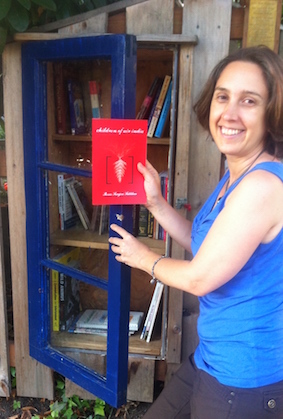
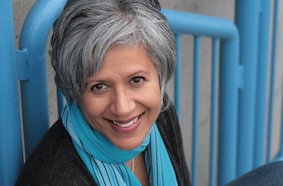 Our first guest, Renée Sarojini Saklikar, is part of the local Indian community. In her poetry book Children of Air India (published by local book publisher Harbour Publishing), she talks about an event that deeply affected the local Indian community: the attack to an Air India flight, where many people from the community died.
Our second guest, George K. Ilsley, is originally fr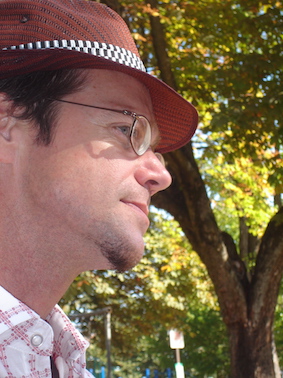 om Nova Scotia but has lived in Vancouver for the past couple of decades. His book Manbug, (published by Vancouver small press publisher Arsenal Pulp Press) about the life of a peculiar gay couple, brings to the discussion issues of disability and normalcy, stereotypes, the use of labeling and dichotomies, and the reality of a spectrum of gender / normalcy / and ability, where we all fit.
Our third gu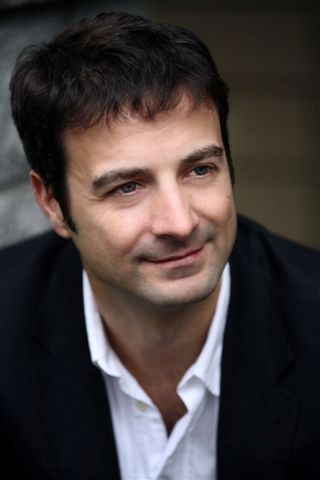 est, Daniel Kalla, is a Jewish doctor born and raised in Vancouver. His book The Far Side of the Sky is a historic novel based on real events and memoirs from members of the Jewish community that settled as refugees in Shanghai at the end of WWII.
Our fourth guest, Alyson Quinn, was born and grew up in Rhodesia 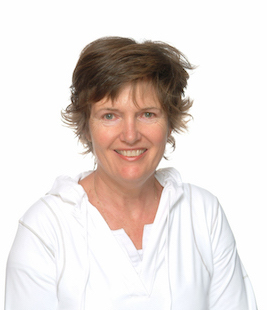 (today Zimbabwe) and South Africa. Her book When the River Wakes Up is a novel based on her memoirs of growing up as a white African at a time when the country was undergoing tremendous changes. Being a social worker, she discussed the differences of cultures that “live in their heads” and those who “live in their hearts.”
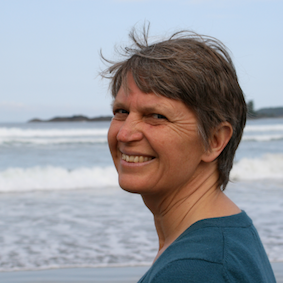 Our last guest, biologist and author Ann Eriksson, lives in Thetis Island but was kind enough to visit us and stay late for the occasion. We read her book High Clear Bell of Morning (published by Canadian independent publisher Douglas & McIntyre) and discussed issues of mental health and the destruction of our environment, with a focus on the contamination of the ocean and its effect on marine mammals in our region.
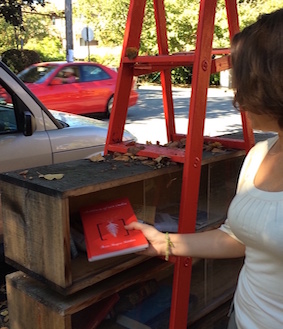
Having to borrow and lend the books gave an excuse for neighbours to visit and get to know each other. They met also during the readings and discussed several issues that matter to all of us. After 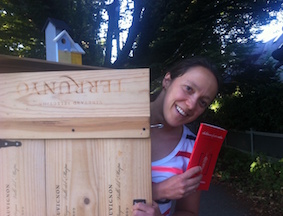 the discussions, the books were distributed among the small community libraries that have popped up around the city as part of local efforts to increase the “sharing community”. All the copies can then be borrowed by and circulated among other neighbours.
The project aimed to tighten the connections between neighbours, with a special emphasis in crossing ethnic, religious, professional and other boundaries that artificially separate us. The topics discussed touched on the suffering that any type of violence generates: violent attacks by terrorists or by war (specifically, religious and ethnic violence), the violence of stereotypes and narrow categories (in the areas of gender, ability and mental health), the violence of colonialism and racism, and the violence against the environment through contamination. The discussions helped us reflect and consider other, wider options of being in the world.
Great project. Hope to see you sometime soon.